
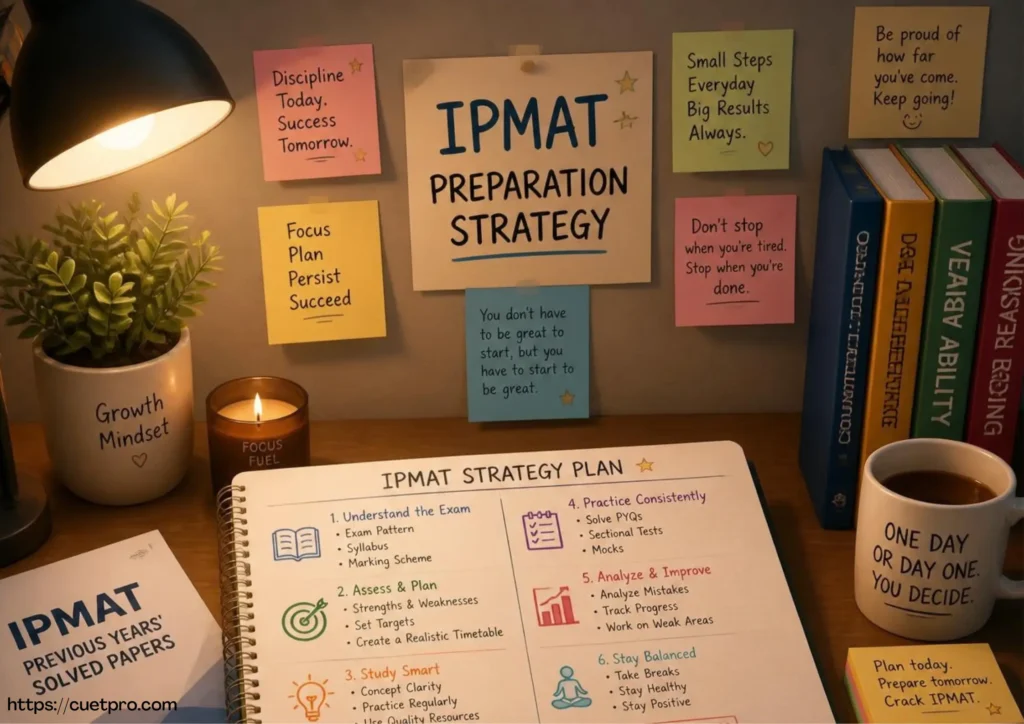
IPMAT tests aptitude, not your Board syllabus. With 8 months to May, build Quant and Verbal fundamentals first (add Logical Reasoning if your target exam needs it), then move to sectional tests, full-length mocks and PYQs — with a study plan that runs alongside Boards, not instead of them.
IPMAT at a Glance
IPMAT (Integrated Programme in Management Aptitude Test) is the entrance exam for the 5-year Integrated Programme in Management (IPM) — a course combining undergraduate and postgraduate management education in one programme.
| Exam | Conducted By | IIM |
|---|---|---|
| IPMAT Indore | IIM Indore | IIM Indore |
| IPMAT Rohtak | IIM Rohtak | IIM Rohtak |
| JIPMAT | NTA | IIM Jammu, IIM Bodh Gaya |
These are three separate exams — a score from one doesn’t carry over to the others. Scores from IPMAT Indore and IPMAT Rohtak are also accepted by some other institutes (IIM Ranchi, IIM Shillong, IIFT, NALSAR, Nirma University, TAPMI, in past cycles) — always confirm the current-year list before applying.
Basic eligibility (all three exams):
- Passed Class 12, or appearing in the exam year
- Minimum 60% in Class 10 and 12 (55% for SC/ST/PwD)
- Age cap of around 20 years, with relaxation for reserved categories
- No stream restriction — Science, Commerce, Humanities all eligible
- Maths is not a compulsory Class 12 subject for any of the three exams
Understand the IPMAT Exam
No exam publishes a strict official syllabus — the pattern below reflects consistent recent trends. Figures reflect the latest released cycle; confirm exact numbers against the current-year official notification.
| Factor | IPMAT Indore | IPMAT Rohtak | JIPMAT |
|---|---|---|---|
| Sections | Quant (MCQ), Quant (Short Answer), Verbal | Quant, Logical Reasoning, Verbal | Quant Aptitude, DI & Logical Reasoning, Verbal & RC |
| Questions | 90 | 120 | 100 |
| Duration | 120 min (40 min/section, strict sectional limits) | 120 min (no sectional limit) | 150 min (no sectional limit) |
| Marking | +4/−1 for MCQs; no negative marking on Short Answer | +4 correct, −1 wrong, 0 unattempted | +4 correct, −1 wrong, 0 unattempted |
| Selection process | Test → Personal Interview → Composite Score | Test → further shortlisting per IIM Rohtak’s policy | Primarily test score + academics; typically no interview |
Core syllabus areas (all three exams draw from these):
- Quant: Arithmetic (percentages, profit-loss, ratios, time-speed-distance), Number System, Algebra basics, Geometry, Probability/Permutation-Combination, Data Interpretation
- Verbal: Vocabulary, Grammar, Reading Comprehension, Para-jumbles, Critical Reasoning
- Logical Reasoning (Rohtak, JIPMAT): Puzzles, seating arrangement, blood relations, coding-decoding, syllogisms
IPMAT Preparation Strategy: Your 8-Month Plan
With about 8 months left until May, follow three steps — don’t jump to advanced practice before the basics are solid.
| Step | Months | What to Do | Tests |
| Step 1: Build the Base | Months 1–4 (July–October) | Learn concepts, build content knowledge and solidify fundamentals in Quant, Verbal and Logical Reasoning Start a daily reading habit | Topic-wise practice sets only |
| Step 2: Sectional Tests | Months 5–6 (Nov.–December) | Take sectional tests, tackle sectional challenges and strengthen your weak sections | Start sectional tests in Month 5 (weekly) |
| Step 3: Mocks & PYQs | Months 7–8 ( January – Feb) | Take full-length mocks and solve previous years’ papers under timed conditions Analyse every mistake; light revision only in the final week | Start full-length mocks in Month 7 (weekly, more often in Month 8) |
A. Section-Wise Strategy
Cover each section in three stages that match the steps above.
| Stage | Quantitative Ability | Verbal Ability | Logical Reasoning (Rohtak & JIPMAT) |
| Stage-1 Months 1–4 | 1. Number System 2. Percentages 3. Ratio 4. Averages 5. Profit & Loss 6. Interest 7.Time-Speed-Distance 8. Time & Work 9. Algebra Basics 10. Geometry Fundamentals | 1. Vocabulary 2. Parts of Speech 3. Grammar 4. Sentence Correction 5. Short Reading Comprehensions | 1. Blood Relations 2. Coding-Decoding 3. Basic Puzzles 4. Syllogisms |
| Stage-2 Months 5–6 | 1. Advanced Algebra 2. Functions 3. Permutation & Combination 4. Probability 5. Sectional Tests 6. Weak-Topic Revision | 1. Long Reading Comprehensions 2. Para-jumbles 3. Sentence Arrangement 4. Critical Reasoning 5. Sectional Tests 6. Weak-Area Revision | 1. Advanced Seating Arrangements 2. Logical Puzzles 3. Data Interpretation – Tables 4. Data Interpretation – Graphs 5. Data Interpretation – Caselets 6. Sectional Tests |
| Stage- 3 Months 7–8 | 1. Full-Length Mocks 2. Previous-Year Questions (PYQs) 3. Mixed Sets 4. Formula Revision 5. Error Analysis | 1. Full-Length Mocks 2. Previous-Year Questions (PYQs) 3. Vocabulary Revision 4. Grammar Revision 5. Error Analysis | 1. Full-Length Mocks 2. Previous-Year Questions (PYQs) 3. Mixed LR + DI Sets 4. Speed Practice 5. Accuracy Improvement |
B. Daily Study Plan (2–3 Hours)
| Time | Activity |
|---|---|
| 40–45 min | Quantitative Ability — one topic, practice set |
| 30 min | Verbal Ability — vocabulary/grammar drill or one RC passage |
| 20–30 min | Reading (newspaper/editorial/varied-topic article) — build comprehension speed |
| 30 min | Logical Reasoning practice (if your target exam needs it) |
| 15–20 min | Revision — revisit yesterday’s mistakes, formulas, or new words |
Rotate topics within Quant/Verbal/LR daily rather than repeating the same topic for days — this builds recall under mixed conditions, closer to the actual exam.
FAQs
Q. Can I get into IIM after 12th?
Ans: Yes — the IPM programme at IIM Indore, IIM Rohtak, IIM Jammu, and IIM Bodh Gaya admits students directly after Class 12 through IPMAT/JIPMAT.
Q. Is Maths compulsory?
Ans: No, Mathematics as a Class 12 subject isn’t a stated eligibility requirement. But since Quant is tested in every IPMAT/JIPMAT exam, non-Maths students need to build that foundation separately.
Q. Can Commerce students apply?
Ans: Yes — there’s no stream restriction across IPMAT Indore, IPMAT Rohtak, or JIPMAT.
Q. Can I crack the IPMAT without coaching?
Ans: Yes, with a structured self-study plan (fundamentals → sectional tests → full-length mocks and PYQs) and consistent mistake analysis. Coaching can add structure and peer benchmarking, but it isn’t mandatory.
Q. How many hours should I study?
Ans: A consistent 2–3 hours daily works better than irregular long sessions — especially alongside Board preparation. Total hours matter less than consistency and mock-test review.
Q. Can I prepare for IPMAT and CUET together?
Ans: Yes — use NCERT/Board study as your shared content base for CUET, and treat IPMAT’s Quant/Verbal/LR practice as a separate daily aptitude track alongside it.
Related Articles:
