
The Common University Entrance Test (CUET-UG) is one of the major entrance routes for undergraduate admissions in India. However, CUET does not follow a single subject combination or merit formula for every university and course. Eligibility and the subjects considered for merit can vary across universities and programmes, making subject selection an important part of your admission strategy.
For CUET-UG 2026, the official NTA syllabus includes 37 test papers — 13 languages, 23 domain subjects and the General Aptitude Test (GAT). Students can select up to five subjects, but all selected subjects are not necessarily considered for every course. The required combination depends on the programme and university you are applying to.
Therefore, understanding which subjects are required, which scores count towards merit, and how combinations differ across courses is essential before finalising your CUET subject choices.
CUET UG organises subjects into three broad groups:
| Group | What it covers | Example subjects |
| Language subjects (List A) | Reading comprehension, vocabulary, verbal ability | English, Hindi, Tamil, Bengali, Urdu, and other scheduled languages |
| Domain subjects (List B1/B2) | Subject-specific content, mostly based on Class 12 curriculum | Economics, Accountancy, History, Political Science, Mathematics, Physics, Psychology, and others |
| General Aptitude Test (GAT) / Section III | General Knowledge, Numerical Ability, Reasoning | Not tied to any Class 12 subject |
Students can register for up to 5 subjects total (languages + domains + GAT combined) while filling the CUET form. But choosing 5 subjects doesn’t mean all 5 will be used by every course you apply to — each course specifies its own required combination, and only those specific papers are picked up for that course’s merit list.
Why the Combination Matters After the Exam?
CUET is a single exam, but it feeds admissions to hundreds of different courses across hundreds of universities, each with its own eligibility rules. The combination you choose determines which of those courses you’re even eligible to apply for — it’s decided before the exam, at the subject-selection stage, not after.
CUET Score vs Merit Score: How Subject Combinations Affect Merit?
Students often use CUET score and merit score interchangeably, but they are different. Your CUET result contains subject-wise scores, while the score considered for admission depends on the subjects prescribed for your chosen course.
CUET Score vs Merit Score
- Raw Score: Marks obtained in a particular CUET paper according to the applicable marking scheme, generally +5 for correct and −1 for incorrect answers.
- Normalised Score: Since CUET is conducted across multiple shifts, NTA uses a normalisation process to account for differences in paper difficulty. The resulting subject-wise score is reported for that subject.
- Merit Score: A university considers only the specific subjects required for your chosen course and applies that course’s prescribed merit formula. It does not automatically add the scores of every subject you appeared for.
Illustrative Example
Suppose a course requires 1 Language + Economics + Psychology:
| Applicant | Subject | Normalised Score |
| A | Hindi | 152.60 |
| A | Economics | 170.27 |
| A | Psychology | 168.50 |
| B | English | 169.71 |
| B | History | 171.61 |
| B | Sociology | 159.50 |
If Applicant A meets the prescribed language requirement, the relevant scores would be Hindi + Economics + Psychology. Scores in other subjects would not automatically be added.
This is a simplified illustration based on a published sample-score document from Dr. B.R. Ambedkar University Delhi’s 2022 admission bulletin. It is not a current DU merit formula or cutoff.
How Subject Combinations Affect Merit?
Your CUET subject choices can affect both eligibility and merit calculation:
- Specific Language: Some courses require a particular language, such as English, rather than any language.
- Specific Domain: Some programmes have mandatory subjects. For example, BA (Hons.) Economics at DU requires Mathematics/Applied Mathematics.
- Multiple Combinations: Certain courses, such as BA (Hons.) English and B.Com, may allow more than one recognised subject combination.
- GAT Requirement: Programmes such as BMS, BBA (Financial Investment Analysis), and BA (Hons.) Business Economics have specific combinations involving the General Aptitude Test.
- Extra Subjects: Taking additional subjects can provide backup options for other courses, but their scores do not automatically increase your merit for a course.
- Irrelevant Subjects: A high score in a subject that is not accepted for your target course may not be considered.
Also read: How Much to Score in CUET for DU Admission
The Key Takeaway
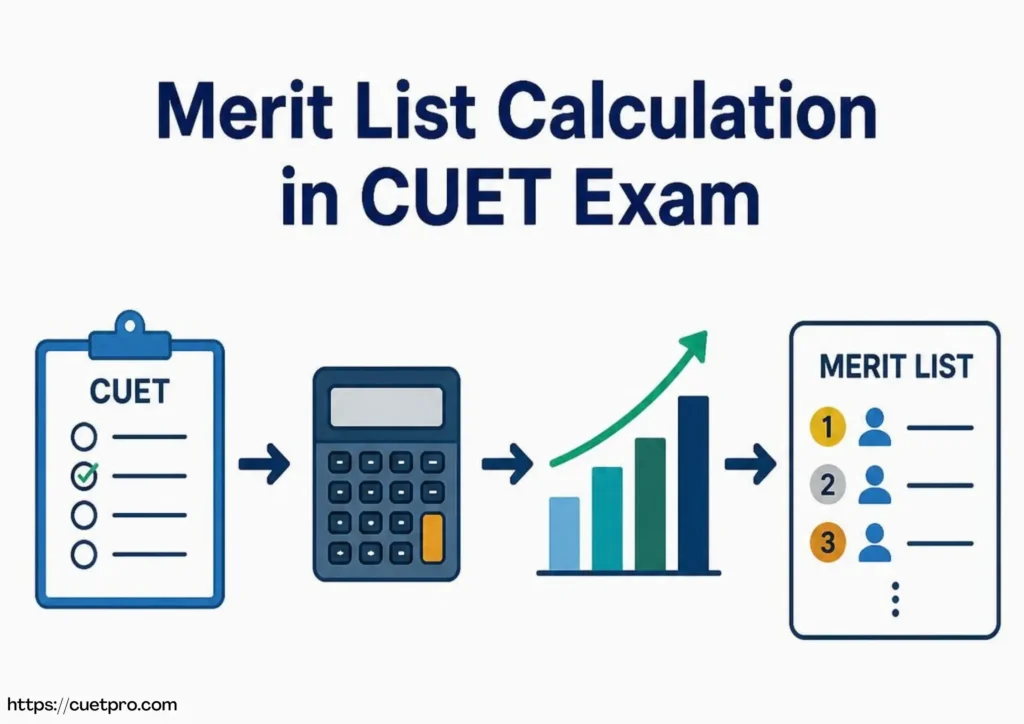
CUET Score → Eligible Subjects → Prescribed Combination → Course-Specific Merit
Therefore, choosing CUET subjects should not be based only on which subjects you expect to score well in. Check the latest official eligibility and subject-combination requirements for your target courses before making your choices.
Course-Wise Examples
The following examples are based on CUET UG 2026 admission requirements published by DU, JNU and BHU. Since subject combinations can change, students should always verify the latest official admission bulletin before applying.
| University | Course | Typical CUET Subject Combination (2026) | Key Point |
| DU | B.Com. (Hons.) | 1 Language + Mathematics + 2 List B subjects OR 1 Language + Accountancy + 2 List B subjects | Mathematics and Accountancy routes are both accepted. |
| DU | B.A. (Hons.) Economics | 1 Language + Mathematics/Applied Mathematics + 2 List B subjects | Mathematics/Applied Mathematics is compulsory. |
| DU | B.A. (Hons.) Political Science | 1 Language + 3 List B subjects OR 2 Languages + 2 List B subjects | More than one valid combination is available. |
| DU | BMS / B.A. (Hons.) Business Economics / BBA (FIA) | Language + Mathematics + 1 List B subject + GAT | GAT and Mathematics are important components for these programmes. |
| JNU | B.A. (Hons.) Foreign Languages | English + GAT | The combination applies to programmes including Persian, Arabic, Japanese, Korean, Chinese, French, German, Russian and Spanish. |
| JNU | B.Sc. in Ayurveda Biology | Physics + Chemistry + Biology OR Mathematics | Candidates need three CUET subjects, with Biology or Mathematics as the third subject. |
| BHU | B.A. (Hons.) – Faculty of Arts | English/Hindi + GAT | Applies to programmes such as English, History, Political Science, Geography and other Faculty of Arts subjects. |
| BHU | B.Com. (Hons.) / B.Com. (Hons.) Financial Market Management | Accountancy + Business Studies + GAT | All three listed CUET components are required. |
Does Taking More CUET Subjects Increase Your Merit Score?
No — not automatically, and not for the course you’re actually targeting.
Here’s the distinction that trips students up: taking more subjects can be useful for keeping options open across multiple courses or universities, since each course only looks at its own required combination out of everything you attempted. But for any single course’s merit calculation, only the mandated subjects are used — an extra subject with a great score sitting outside that combination simply isn’t picked up.
When additional subjects are useful:
- You’re unsure between two courses with different subject requirements (e.g., Economics Hons vs. a Humanities BA), so you take subjects covering both.
- You want a backup option at a different university with different eligibility rules.
When they don’t help:
- You’re confident about one target course, and its combination is already fixed — extra subjects beyond that combination add exam-day pressure without adding to that course’s score.
- You assume “more subjects = better average” — merit isn’t calculated as an average across everything you attempted; it’s calculated only from the prescribed combination.
Taking more subjects is a hedging strategy for flexibility, not a scoring strategy for any one course.
How to Choose CUET Subjects Strategically?
- Shortlist your target courses — list every course/university combination you’re realistically considering.
- Check university eligibility — confirm you meet each course’s Class 12 and CUET-based eligibility norms.
- Identify mandatory subjects — note which specific language(s) and domain subject(s) each shortlisted course requires.
- Check which subjects are used for merit — confirm that the subjects you plan to take are the ones actually picked up in that course’s merit formula, not just “accepted” broadly.
- Check whether GAT is required — some courses need it, some don’t; don’t assume either way.
- Compare overlapping requirements across courses — look for a subject combination that satisfies multiple target courses at once, to maximise flexibility within your 5-subject limit.
- Finalise subjects accordingly — lock in your combination only after this cross-check, not before.
This process improves the odds that your subject choices align with what your target courses actually need — it is a planning framework, not a guarantee of eligibility, merit rank, or admission, since final rules are set by each university for that specific year.
FAQs
Q1. Does CUET subject combination affect merit?
Ans: Yes. Universities calculate merit only from the specific subjects mandated for a course, so your subject combination directly determines both your eligibility and which scores count toward your merit for that course.
Q2. Can I change my subject combination after CUET?
Ans: No. Once you’ve appeared for your chosen CUET subjects, that becomes your fixed subject list for that admission cycle — you cannot add subjects you didn’t attempt.
Q3. Do all CUET subjects count towards admission?
Ans: No. Only the subjects that match a specific course’s prescribed combination are used for that course’s merit calculation — other subjects you attempted are simply not picked up for that course.
Q4. Does taking more subjects increase my score?
Ans: No, not for a single course’s merit calculation. More subjects mainly add flexibility to apply across different courses, not a higher score within one course’s fixed combination.
Q5. Is GAT compulsory for every course?
Ans: No. It’s required for specific programmes (commonly management-oriented courses like BMS/BBA at DU) but not universally mandatory — check each course’s bulletin.
Q6. What happens if I did not take a required domain subject?
Ans: You typically become ineligible for that specific course, even with a strong overall CUET performance in other subjects.
Q7. Can the same CUET combination work for different DU courses?
Ans: Sometimes, if the courses share overlapping subject requirements (as in Student C’s and Student E’s examples above), but this isn’t guaranteed — each course’s requirement should be checked individually.
Q8. Are CUET subject requirements the same for every university?
Ans: No. Requirements are set by each participating university/course individually and can differ significantly — a combination valid for DU may not satisfy BHU, JNU, or another university’s criteria.
Q9. How is my CUET raw score converted for merit?
Ans: NTA converts raw marks into a subject-based normalised score to account for differences across exam shifts; universities use this normalised score, not the raw marks, for merit.
Q10. Will subject combination rules stay the same next year?
Ans: Not necessarily. Universities can revise eligibility combinations between cycles (as DU did for BA Hons English), so always confirm against the current year’s official bulletin rather than a previous year’s.
Related Articles:
