
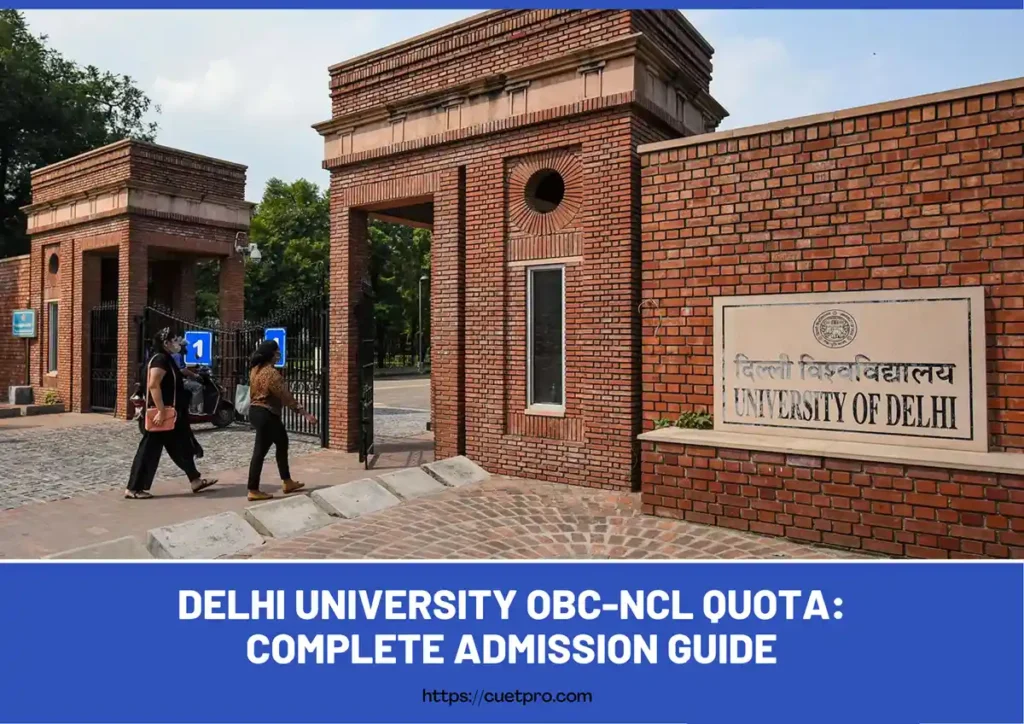
OBC reservation is one of the largest reservation categories at Delhi University, and also one of the most misunderstood — largely because of a single mix-up between Central and State OBC lists. This guide walks CUET 2026 aspirants, OBC category students, parents, and counselors through everything required for the DU OBC Quota 2026: eligibility, the non-creamy layer rule, certificate format, documents, and the mistakes that most often get applications rejected.
OBC reservation gives candidates from socially and educationally backward classes fair access to higher education. The “Non-Creamy Layer” condition narrows this further to families that are also economically backward, since better-off OBC families (the “creamy layer”) are excluded. At Delhi University, OBC-NCL reservation is governed entirely by Central Government rules, not state-level policy — precisely where most confusion, and most rejected applications, originates.
What is OBC (Non-Creamy Layer) Reservation in Delhi University?
Delhi University reserves 27% of seats across all colleges and programmes for OBC-NCL candidates, in line with the Central Educational Institutions (Reservation in Admissions) Act, 2006. This applies uniformly — whether the programme is a popular honours course or a niche postgraduate one — provided the candidate meets the caste, income, and certificate conditions.
Quick Facts: DU OBC-NCL Quota at a Glance
| Particulars | Details |
| Reservation Percentage | 27% |
| Applicable Category | OBC-NCL |
| Income Limit | Below ₹8 Lakh per annum |
| Certificate Requirement | Mandatory |
| Governing Law | CEI (Reservation in Admissions) Act, 2006 |
| Sample Certificate | Sample OBC Certificate |
OBC-NCL Eligibility Criteria for DU Admission
Eligibility for DU OBC Eligibility rests on four pillars, and missing any one of them can disqualify an otherwise strong application.
1. Caste Requirement
The candidate’s caste must appear in the Central OBC List maintained by the National Commission for Backward Classes (NCBC). A caste recognised as OBC by a state government but absent from the Central List does not qualify for reservation at DU.
2. Income Requirement
The family’s gross annual income must be below ₹8 lakh. This threshold determines whether a candidate falls within the non-creamy layer.
3. Non-Creamy Layer Requirement
Beyond income, the non-creamy layer status also considers parental occupation and rank — for instance, children of high-ranking government officers or certain high-income professionals may be classified as “creamy layer” even if income is marginally under the limit, depending on the specific OM provisions.
4. Certificate Requirement
A valid, recently issued OBC-NCL certificate in the student’s own name (not the parent’s) is mandatory, and it must meet the validity window prescribed by DU for that admission cycle.
Eligibility Snapshot:
| Eligibility Condition | Requirement |
| Central OBC List | Mandatory |
| Non-Creamy Layer Status | Mandatory |
| Income Limit | Below ₹8 Lakh |
| Valid Certificate | Mandatory |
Central OBC List vs State OBC List: The Biggest Mistake Students Make
This is, without question, the single most common reason genuinely eligible OBC students lose their reservation benefit at DU.
What is the Central OBC List?
The Central OBC List is maintained by the NCBC and is specific to each state — meaning a caste is listed against the state where it is recognised as backward at the central level. This is the only list Delhi University, as a Central Educational Institution, is legally permitted to honour.
NCBC Website: To check whether your community is included in the Central List of OBCs, visit the National Commission for Backward Class
What is the State OBC List?
Many state governments maintain their own, broader OBC lists for state-run institutions and state government jobs. These lists often include castes that are not part of the Central List, or classify the same caste differently.
Which One Does Delhi University Accept?
DU accepts only Central OBC List certificates. A State OBC certificate, even if completely valid for state university admissions or state government recruitment, will not be accepted at DU.
Central vs State OBC List Comparison:
| Feature | Central OBC List | State OBC List |
| Accepted by DU | Yes | No |
| Used for Central Institutions | Yes | No |
| Used for State Admissions | Sometimes | Yes |
Practical example: A student whose caste is recognised as OBC under her state list but not the Central List can use that certificate for a state university, but it will be rejected at DU. The reverse also happens: some castes sit on the Central List but not a state’s own list. The safest step is to check the caste’s status directly on ncbc.nic.in before applying, rather than assuming based on past use of a state certificate.
Also read: Delhi University Sports Quota Admission Guide
Understanding the Creamy Layer Rule
What is Creamy Layer?
“Creamy layer” refers to relatively advantaged members within an OBC community — typically based on parental income, occupation, or rank — who are excluded from reservation benefits because the policy intends to help only the socially and economically backward sections.
What is Non-Creamy Layer?
“Non-creamy layer” candidates are those who fall below the prescribed income and occupational thresholds, making them eligible for OBC reservation benefits.
Why the Distinction Exists
The distinction ensures reservation benefits reach families that genuinely need them, rather than being disproportionately availed by already well-off members of an OBC community.
Example: A student whose family runs a small shop earning ₹5 lakh a year would typically qualify as non-creamy layer. A student whose parent is a senior government officer, or whose family income exceeds ₹8 lakh, would usually fall under the creamy layer and not be eligible — even with a genuinely OBC-listed caste.
OBC-NCL Certificate: Most Important Document
Why is the Certificate Required?
The OBC Non-Creamy Layer Certificate is the only document that simultaneously proves caste status and income/occupation eligibility. Without it, no claim under this quota can be processed, regardless of how strong the CUET score is.
Validity Rules
The OBC-NCL Certificate must be issued after the prescribed cut-off date announced by DU for that admission cycle (for the 2025-26 cycle, this was March 31, 2026). For 2026, watch the official DU CSAS bulletin for the exact date — as a rule of thumb, the certificate should be freshly issued within the same calendar year as the admission.
Outdated certificates are routinely rejected because income and creamy-layer status can change year to year. If your existing certificate predates the cut-off, you’ll typically need a fresh certificate or an accompanying current non-creamy layer status certificate.
DU OBC-NCL Certificate Format Explained
| Certificate Component | Required |
| Student Name | Yes |
| Date of Birth | Yes |
| Father’s Name | Yes |
| Caste Name | Yes |
| Central List Entry (with state and serial number) | Yes |
| Non-Creamy Layer Declaration | Yes |
| Issuing Authority | Yes |
| Seal & Signature | Mandatory |
Common Certificate Errors
Students frequently run into trouble when the certificate is issued in a parent’s name instead of the student’s, when the caste entry doesn’t match the Central List wording for that state, when the non-creamy layer declaration is missing entirely, or when the certificate predates DU’s cut-off date. Any one of these can cause rejection during verification, even for a genuinely eligible student.
How to Obtain an OBC-NCL Certificate?
- Verify caste in the Central OBC List on ncbc.nic.in before starting the application.
- Gather income documents, such as parents’ IT returns or salary slips, to support the non-creamy layer declaration.
- Visit the competent authority in your district — typically the District Magistrate, Sub-Divisional Magistrate, Tehsildar, or Executive Magistrate’s office.
- Submit the application along with caste and income proof, and the prescribed application form.
- Verification process, where the authority checks the submitted documents and family records.
- Certificate issuance, after which the certificate becomes valid for use, typically for one year from the date of issue.
Authorities commonly authorised to issue this certificate include the District Magistrate, Additional District Magistrate, Sub-Divisional Magistrate, Taluka Magistrate, Executive Magistrate, Extra Assistant Commissioner, and Presidency Magistrate (where applicable).
Documents Required for OBC-NCL Admission
| Document | Mandatory |
| OBC-NCL Certificate | Yes |
| CUET Scorecard | Yes |
| Class 10 Certificate | Yes |
| Class 12 Certificate | Yes |
| Aadhaar Card | Yes |
| Income Proof | Supporting |
| Passport Photographs | Yes |
Note: most DU CSAS uploads require self-attested photocopies rather than notarised ones — the candidate signs each copy declaring it a true copy of the original. Keep originals safe for physical verification, since self-attestation doesn’t replace checking against originals.
Common Reasons for OBC Admission Rejection
The most frequent rejection triggers include submitting a State OBC certificate instead of a Central one, an outdated certificate issued before DU’s cut-off date, family income exceeding ₹8 lakh, a missing non-creamy layer declaration, a mismatched caste entry, and name or date-of-birth mismatches across the certificate, board records, and Aadhaar. The fix for nearly all of these is the same: verify caste on ncbc.nic.in, get a fresh certificate close to the admission cycle, and proofread every document against your board certificates before uploading.
Also read: Delhi University NSS Quota 2026 Admission Guide
Important Tips for OBC-NCL Candidates
- Check your caste’s Central OBC List status on ncbc.nic.in well before CUET registration.
- Renew your OBC-NCL certificate so it’s issued after DU’s prescribed cut-off date for the cycle.
- Verify that names, father’s name, and date of birth match exactly across all documents.
- Keep at least three to four photocopies of every document ready in advance.
- Upload clear, high-resolution scans — blurry or cropped images are a common cause of delay.
- Preserve all original documents for the physical verification stage.
- Confirm the certificate explicitly carries a non-creamy layer declaration, not just a caste statement.
- Self-attest every photocopy as required by the CSAS document checklist.
- If your family’s income situation has changed recently, get income proof updated before applying for the certificate.
- Track DU CSAS announcement dates for certificate cut-off deadlines, as these can shift slightly each cycle.
- When in doubt about your eligibility, consult the issuing authority’s office directly rather than relying on assumptions from a previous admission cycle.
Advantages of OBC Reservation in DU
The OBC-NCL quota reserves a substantial 27% of seats, significantly improving admission odds for eligible candidates across every DU college and most programmes. Since it applies university-wide, it gives students broader access to competitive courses they might otherwise miss through the general category alone. It also factors into seat allocation separately, meaning eligible candidates compete mainly against others in the same category rather than the entire applicant pool — a meaningful edge for well-prepared OBC-NCL students.
Conclusion
Admission under the Delhi University OBC-NCL Admission route comes down to four essentials: confirming your caste is on the Central OBC List, staying within the non-creamy layer income threshold, holding a certificate that’s correctly formatted and issued within DU’s validity window, and submitting a complete, consistent document set alongside your CUET score. The single biggest avoidable mistake remains confusing Central and State OBC lists, so verify your status on ncbc.nic.in well in advance. Start the certificate renewal process and gather your documents before DU CSAS registration opens for 2026 — it’s the surest way to keep your reserved seat within reach.
Frequently Asked Questions (FAQs)
Q. What is OBC-NCL reservation in DU?
Ans: It’s a 27% reservation for Other Backward Classes candidates who fall outside the “creamy layer,” meaning their family income and parental occupation are below prescribed thresholds.
Q. How much reservation is available under this category?
Ans: 27% of seats across DU colleges and programmes are reserved for OBC-NCL candidates.
Q. Does DU accept State OBC certificates?
Ans: No. DU only accepts certificates for castes listed in the Central OBC List maintained by the NCBC.
Q. What is the income limit for OBC-NCL?
Ans: Family gross annual income must be below ₹8 lakh to qualify as non-creamy layer.
Q. What is the creamy layer?
Ans: It refers to relatively advantaged members of an OBC community — based on income, occupation, or rank — who are excluded from reservation benefits.
Q. Is CUET compulsory for OBC-NCL admission?
Ans: Yes, admission is based on CUET merit; OBC-NCL candidates compete within their category using their CUET score.
Q. Can I apply without a certificate?
Ans: No. A valid OBC-NCL certificate is mandatory to claim this quota; without it, the application will be processed under the general category.
Q. Which authority can issue the OBC-NCL certificate?
Ans: Authorities like the District Magistrate, Sub-Divisional Magistrate, Tehsildar, or Executive Magistrate are commonly authorised to issue it.
Q. How long is the OBC-NCL certificate valid?
Ans: Typically one year from the date of issue, and it must be issued after the cut-off date DU prescribes for that admission cycle.
Q. Can I update my certificate later if it’s outdated?
Ans: Yes, you can obtain a fresh certificate or an accompanying current non-creamy layer status certificate before the verification deadline.
Q. Is OBC reservation available in all DU colleges?
Ans: Yes, the 27% reservation applies across participating colleges and programmes university-wide.
Q. What happens if my certificate is rejected during verification?
Ans: Your claim under the OBC-NCL quota may be denied, and you may be considered under the general category instead, subject to CSAS rules.
Q. How do I check whether my caste is in the Central List?
Ans: Visit ncbc.nic.in and search the Central OBC List for your state to confirm your caste’s listing and serial number.
Q. Can I apply under EWS and OBC simultaneously?
Ans: No, EWS and OBC-NCL are separate reservation categories; a candidate is considered under the category for which they hold a valid, applicable certificate, not both simultaneously.
Q. Does OBC reservation guarantee admission?
Ans: No. It guarantees a reserved share of seats, but admission within that share is still decided by CUET merit among eligible OBC-NCL applicants.
